MIG Switch Risks: What Actually Happens When You Use One on Switch or Switch 2 (2026)
Quick answer: MIG Switch carries four documented risks: permanent console ban from Nintendo Online (confirmed at scale in June 2025), NAND contamination that survives formatting, potential for physical bricking on failed updates, and legal exposure under DMCA and the 2014 EU CJEU ruling. The Switch 2 ban risk is substantially higher than on the original Switch. This article covers what the evidence actually shows, not what sellers claim.
What is MIG Switch and why this risk discussion matters
The MIG Switch (now also sold as MIG Flash) is a physical flash cartridge that inserts into a Nintendo Switch console’s game card slot. It reads game data stored on a microSD card inside the cartridge and presents it to the console as if it were a legitimate game card. The device works on both the original Nintendo Switch and — since firmware update 1.2.0 in June 2025 — the Nintendo Switch 2.
The device is legal to manufacture and sell in most jurisdictions in isolation. What creates risk for users is how Nintendo detects and responds to its use. This article documents those risks using real reported outcomes from 2025 and 2026, not theoretical scenarios.
Risk 1: Console ban — the most immediate and documented risk
The single most significant risk of MIG Switch use is permanent console ban from Nintendo Online Services. This is not a theoretical risk — it was documented at scale in June 2025 when MIG Switch firmware 1.2.0 added Switch 2 compatibility.
The June 2025 ban wave — what actually happened
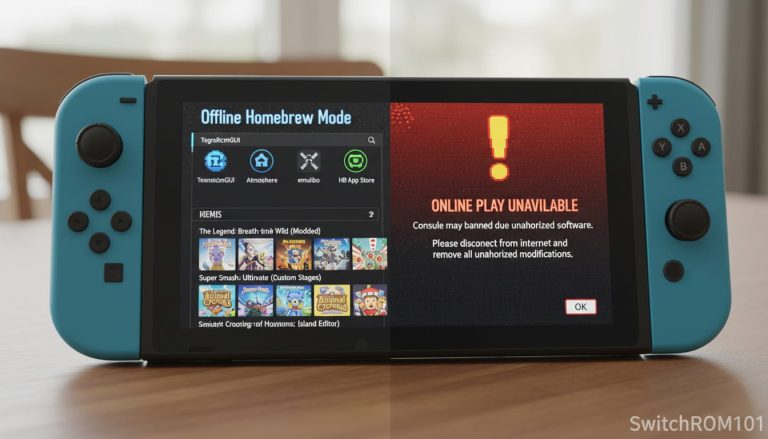
Within 24 hours of MIG Switch firmware 1.2.0’s release, console bans began appearing on Reddit and gaming forums. Nintendo Life reported that Nintendo was “seemingly banning anyone found using the MIG Switch cartridge” on Switch 2. Error code 2124-4508 appeared on affected consoles — Nintendo’s official support page describes this as meaning “the Nintendo Switch console you are using has been permanently banned from connecting to the internet due to a breach of the user agreements.”
Critically, some bans were reported by users who claimed they were using only their own legally-dumped cartridges, not pirated copies. Twitter user SwitchTools reported: “My Switch 2 test has been banned, after using the MIG Switch with perfectly legal dumps of my own cartridges, so it would seem that Nintendo can detect something.” Tom’s Hardware reported that Nintendo has “sophisticated systems in place to detect if multiple consoles share the same cartridge ID” — meaning any dump shared publicly or played on multiple devices generates a ban signal regardless of the user’s intent.
How Nintendo detects MIG Switch use
Each Nintendo Switch game cartridge contains a unique certificate and certificate ID. When a game loads, the Switch transmits this identifier to Nintendo’s servers as part of normal online activity. The MIG Switch uses a single certificate for all dumps loaded on it. Nintendo’s servers flag this when:
- The same certificate ID appears across multiple different consoles simultaneously (public dump detection)
- A certificate ID that does not match Nintendo’s known legitimate cartridge records is presented
- The console transmits data patterns consistent with flash cart hardware behaviour
The ban that results is a console ban, not an account ban. This distinction matters: your Nintendo Account — and the games tied to it — survives a console ban. The banned hardware itself cannot connect to Nintendo Online Services, the eShop, or Nintendo Switch Online from that point forward. Community reports from GBAtemp confirm the ban is hardware-level and survives factory resets.
Ban risk: Switch 2 vs original Switch
The ban risk on Switch 2 is materially higher than on the original Switch for two reasons. First, the Switch 2 requires an internet connection to authenticate Switch 2 Edition upgrades and certain game features, meaning consoles go online more frequently during normal use. Second, Nintendo updated its detection systems alongside Switch 2’s launch in June 2025, making the detection more responsive than the original Switch-era systems.
Community consensus from GBAtemp’s March 2026 threads: users who kept MIG Switch strictly offline on Switch 2 and used only their own private dumps (not publicly shared certificates) reported no bans in extended use. However, forum participants noted that “ban might not happen immediately” and that there is no confirmed method to clear the detection logs Nintendo maintains server-side.
Switch 2 microSD Express Not Working After Update? Here’s the Fix (Firmware 22.0.0)
Risk 2: NAND contamination — the permanent record problem
Nintendo Switch consoles maintain an internal activity log in NAND storage. This log records game certificate accesses, firmware interactions, and network activity. When MIG Switch is used — even briefly — this log is written. The critical finding from the GBAtemp community is stark: formatting the console, performing a factory reset, or even updating firmware does not clear this log.
One community member with extensive Switch modding experience wrote: “Staying offline only prolongs the inevitable as it’s not possible to clear the logs that Nintendo checks for any suspicious activity on your console.” Another confirmed: “If you have inserted the MIG Switch into your Switch at any point in time with a pirated or public dump loaded in it, your switch will get banned shortly after the next time it goes online.”
The practical implication is that the risk does not expire. A console that used MIG Switch months ago and then connects online for an unrelated reason can still trigger a ban. This is qualitatively different from the risk model most users assume.
Risk 3: Physical bricking
Bricking — rendering the console permanently unusable — is a lower probability but irreversible risk. It arises in two specific scenarios:
Failed cart firmware update: MIG Switch cart firmware updates are applied by placing an update.s2 file on the cart’s microSD and inserting it into a powered-on Switch. If this process is interrupted — by a power failure, incorrect file placement, or SD card issues — the cart firmware can be left in a broken state. Most cart bricks are recoverable (replacing the SD card with a correct firmware file and retrying), but edge cases exist.
Nintendo firmware incompatibility: Each Nintendo Switch firmware update can change how the console validates game cartridges. GBAtemp’s firmware compatibility thread for MIG Switch shows that certain firmware releases temporarily broke cart compatibility before MIG Switch firmware updates addressed them. Using an outdated MIG Switch firmware with a newer Switch firmware version has caused some consoles to fail to boot games or, in rare cases, to experience boot loops.
The MIG Switch cart firmware changelog on GBAtemp shows updates specifically addressing compatibility breaks introduced by Nintendo firmware patches — firmware 1.2.3 (October 2025) was released specifically to fix compatibility with Metroid Prime 4: Beyond. This is evidence of an ongoing cat-and-mouse dynamic where Nintendo changes create temporary breakage.
Risk 4: Legal exposure
The legal status of flash cartridges like MIG Switch varies significantly by jurisdiction and specific use case. The device itself occupies a grey area in most legal systems, but specific uses carry clear legal risk:
EU (CJEU Nintendo v. PC Box, 2014): The Court of Justice of the EU ruled that devices designed to circumvent Nintendo’s technological protection measures are illegal under the Software Directive even when the stated purpose is playing legitimately-owned games. This ruling covers the MIG Switch’s core mechanism regardless of the content loaded.
United States (DMCA Section 1201): Circumventing technological protection measures — which is exactly what the MIG Switch does to load non-certified cartridge data — is prohibited under the DMCA. No US court has ruled that personal backup use creates a complete defence against Section 1201 liability.
Using public dumps or non-self-created files: In all jurisdictions, playing game files you did not create from cartridges you own is copyright infringement. This applies regardless of whether you own a copy of the game.
Nintendo has demonstrated willingness to pursue legal action against hardware manufacturers and distributors: the MIG Switch team received a cease-and-desist letter from Nintendo’s lawyers in 2024. The current product sold as “MIG Flash” represents their response to that legal pressure.
Risk summary table
| Risk | Probability | Severity | Is it reversible? |
| Console ban (online use) | High on S2 | Permanent online ban | No — hardware level |
| Console ban (offline only) | Low | Permanent if triggered | No |
| NAND contamination | Certain on use | Delayed ban risk | No — logs persist |
| Physical brick | Low | Console unusable | Partial — often recoverable |
| Legal exposure (EU) | Low-medium | Civil action possible | N/A |
| Legal exposure (US/DMCA) | Low | Civil liability | N/A |
Frequently asked questions
Can I use MIG Switch safely on Switch 2? The June 2025 ban wave showed that Nintendo actively detects MIG Switch use on Switch 2, including from users using only their own private dumps. The risk on Switch 2 is materially higher than on the original Switch and cannot be reliably mitigated by staying offline alone given the NAND log issue.
Does a factory reset clear the ban risk? No. Community evidence consistently shows that NAND logs recording flash cart use persist through factory resets. The ban may be delayed by staying offline, but the log entries remain.
Is MIG Switch legal to own? Owning the hardware is not a criminal offence in most jurisdictions. Using it to circumvent Nintendo’s technological protection measures, or to load game files you did not create from cartridges you own, creates legal exposure under DMCA (US) and equivalent EU law.
What is error code 2124-4508? This is Nintendo’s console ban error code. It indicates a permanent ban from Nintendo Online Services. The message states the console “has been permanently banned from connecting to the internet due to a breach of the user agreements.”

(GameOverlord) has been involved in Nintendo Switch emulation
since 2019. She owns two Nintendo Switch consoles and a Steam Deck OLED,
and has hands-on tested over 40 Switch titles across Ryujinx and
Sudachi emulators. Her background is in consumer electronics and
she has followed emulation law developments in the US, UK, and EU
since the Yuzu shutdown in 2024. SwitchROM101 was built to fill the
gap left by misleading ROM sites — giving gamers accurate, legal,
and technically correct information without hosting any game files.