🔥 Nintendo Switch Homebrew: Legal Status, Risks, and What Nintendo Actually Does (2026)
Homebrew refers to unofficial software that runs on the Nintendo Switch outside of Nintendo’s official ecosystem. This article does not provide installation instructions. Instead, it explains the legal landscape, Nintendo’s actual enforcement history, and the risks users accept when they modify their console — information that is genuinely useful for making an informed decision.
Quick answer
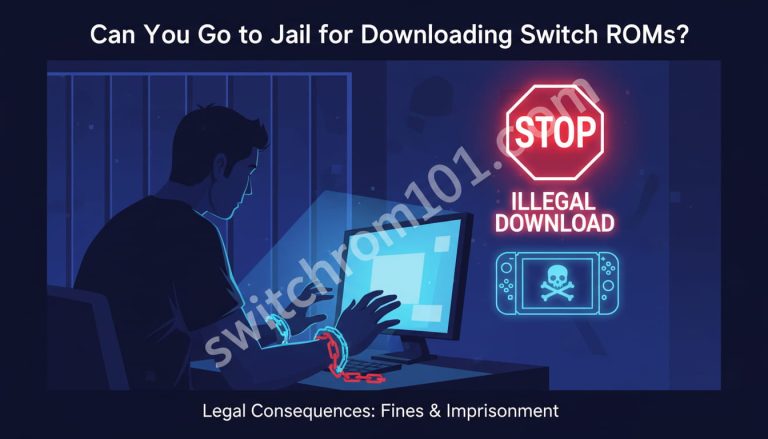
Running homebrew on a Nintendo Switch is not a criminal offence in most jurisdictions. It does, however, void your warranty, violate Nintendo’s Terms of Service, and risk a permanent online ban (Nintendo Account and console). Nintendo’s enforcement focuses on piracy detection, not homebrew use in isolation. The legal and practical risk depends heavily on what you use homebrew for.
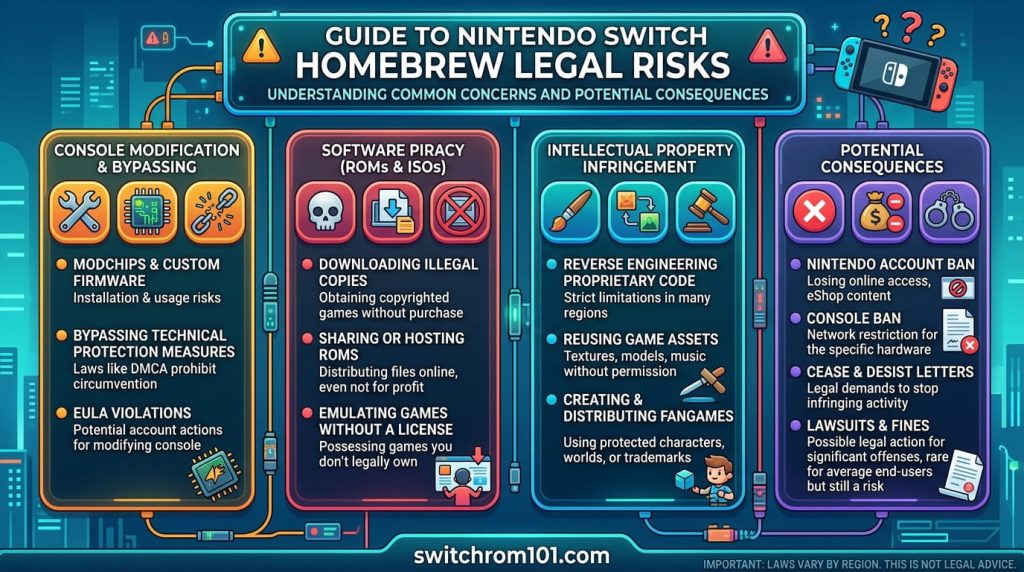
Nintendo Switch homebrew legal risks
The legal answer varies by country and specific activity:
United States: The DMCA prohibits circumventing technological protection measures, but the US Copyright Office has granted exemptions for security research and interoperability. Running homebrew for personal, non-commercial use on hardware you own occupies a legal grey area — it has not been broadly criminalised.
European Union: The EU Software Directive and national implementations vary. Running modified software on hardware you own for personal use is generally not pursued legally.
Nintendo’s position: Nintendo considers any modification a violation of their Terms of Service, regardless of jurisdiction. They retain the right to ban modified consoles from online services.
�� This is educational information, not legal advice. If you have specific concerns, consult a lawyer in your jurisdiction.
What Nintendo actually enforces
Nintendo’s primary enforcement focus is copyright protection — specifically preventing piracy and the distribution of copyrighted game files. Their enforcement record shows:
- Console bans from Nintendo Network and Nintendo eShop for consoles detected using pirated games
- Legal action against piracy infrastructure — Yuzu ($2.4M settlement, 2024), RomUniverse, and other sites distributing games
- Firmware updates that patch known exploits used for homebrew access
Nintendo does not systematically pursue individual users who run homebrew apps that do not involve piracy. The risk of legal action against a private individual for running homebrew on their own console without distributing pirated content is, in practice, very low. The real enforcement mechanism is console banning from online services.
Practical risks of modifying your Switch
Console ban: Nintendo’s servers can detect modified system files or suspicious activity. A banned console loses access to Nintendo eShop, online multiplayer, and Nintendo Account features — permanently.
Warranty void: Any physical modification or software modification voids your Nintendo warranty immediately.
Brick risk: Incorrect modifications can render a console unusable. Recovery depends on whether a NAND backup exists. Without a backup, a bricked console may require hardware-level repair.
Legal liability for piracy: If homebrew is used to play games you do not own, that is copyright infringement — a separate legal matter from homebrew itself.
What homebrew is actually used for (legitimate uses)
Many Switch homebrew users have no interest in piracy. Common legitimate uses include:
- Save management and backup tools
- Custom themes and UI customisation
- RetroArch for emulating older consoles (using legally dumped ROMs)
- Game translation patches for titles not officially localised
- System monitoring and performance tools
- Running Linux for development purposes
None of these uses require piracy. Running emulators on a modded Switch is similar to running emulators on a PC — it is the source of the game files that determines legality.
FAQ about Nintendo Switch homebrew legal risks
Will Nintendo ban me for homebrewing?
Nintendo can ban consoles detected with modified firmware from online services. Users who keep their modded console offline or use separate hardware for online play significantly reduce ban risk.
Is homebrewing your Switch worth it?
That is a personal decision. The legitimate benefits are real for certain users. The risks — warranty void, ban potential, brick possibility — are also real. This guide is not a recommendation either way.
Can you unhomebrew a Switch?
Removing homebrew modifications is possible by restoring a NAND backup or reinstalling official firmware. However, a console that has already been flagged by Nintendo’s servers will remain banned regardless of reverting the hardware.
- Switch 1 Games on Switch 2: What Runs Better, What Needs Old Joy-Cons, What’s Broken (2026)
- Best microSD Express Cards for Switch 2 in 2026: Tested After the Firmware 22 Issue
🕹️Why Does My Ryujinx Keep Crashing? Troubleshooting and Fixes🎮🔧

(GameOverlord) has been involved in Nintendo Switch emulation
since 2019. She owns two Nintendo Switch consoles and a Steam Deck OLED,
and has hands-on tested over 40 Switch titles across Ryujinx and
Sudachi emulators. Her background is in consumer electronics and
she has followed emulation law developments in the US, UK, and EU
since the Yuzu shutdown in 2024. SwitchROM101 was built to fill the
gap left by misleading ROM sites — giving gamers accurate, legal,
and technically correct information without hosting any game files.