Does Homebrewing a Nintendo Switch Void Your Warranty? What Nintendo Actually Does in 2026
Quick answer: Yes, homebrewing a Nintendo Switch voids Nintendo’s official 12-month warranty. Nintendo’s warranty document explicitly excludes products that are “modified or tampered with.” Repair technicians check for CFW traces. Nintendo will refuse paid repairs on detected modded consoles, not just warranty claims. This applies to all Switch models including Switch 2.
What Nintendo’s switch homebrew warranty actually says
Nintendo of America’s official warranty document, available at en-americas-support.nintendo.com, contains this specific exclusion clause: “This warranty shall not apply if this product has been damaged by products not sold or licensed by Nintendo (including, but not limited to, adapters, software, and power supplies).”
A second clause reinforces this: “This warranty shall not apply to damages to the product caused by parts or repairs that are not affiliated with or authorized by Nintendo.”
Homebrewing — installing Atmosphère CFW, modifying system software, or installing a hardware modchip — falls under “software not licensed by Nintendo” and “modifications not authorized by Nintendo.” The warranty exclusion applies from the moment modification occurs, not from the moment a hardware problem appears. Even if your Joy-Con develops drift (a problem unrelated to CFW) after homebrewing, Nintendo can and does refuse warranty coverage on the grounds that the console was modified.
What Nintendo repair technicians actually check
When you send a Nintendo Switch to Nintendo’s repair center, technicians have tools to detect modification. Community reports from GBAtemp and Nintendo support forums confirm the following checks occur:
- Bootloader flags: Hekate and Atmosphère leave identifiable markers in the console’s bootloader configuration that Nintendo’s diagnostic tools can detect, even after the microSD card is removed.
- NAND log analysis: The Switch’s NAND storage maintains system logs. CFW activity — launching Atmosphère, running hbmenu, accessing unofficial apps — creates log entries with signatures that stock firmware does not generate. These persist through factory resets.
- Fuse state inspection: Nintendo Switch hardware includes security fuses that are “burned” (permanently set) by each official firmware update. A console with mismatched fuse state (burned fewer fuses than expected for its current firmware) indicates the firmware was downgraded — a hallmark of CFW usage.
- Hardware inspection for modchips: For patched consoles that require hardware modchips, physical inspection during disassembly reveals the modification.
The important implication: removing the microSD card and “cleaning” your setup before sending the console for repair does not reliably work. The NAND logs, fuse state, and bootloader flags persist. Experienced repair technicians report that “if they find homebrew it immediately goes back in the box” — meaning the repair is refused entirely, not just the warranty claim. Community members have reported Nintendo refusing even out-of-warranty paid repairs on modded consoles.
The full consequence ladder — not just warranty
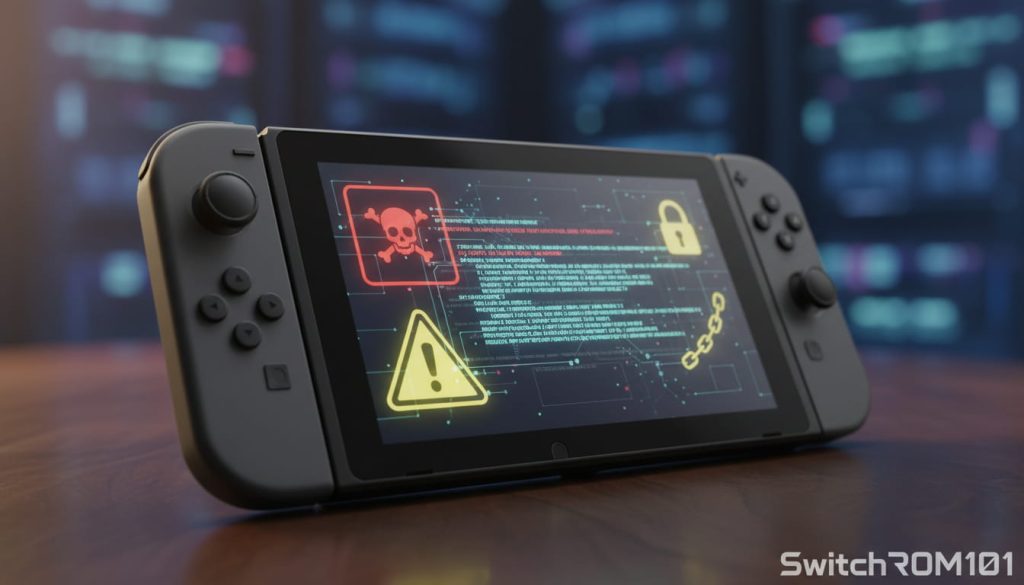
| Situation | What happens with homebrew detected |
| In-warranty hardware fault (e.g. Joy-Con drift) | Warranty claim refused. Console returned unrepaired. |
| Out-of-warranty paid repair request | Paid repair refused in many documented cases. |
| Console sent in for battery replacement | Repair refused or returned. Battery not replaced. |
| Screen damage repair | Repair refused or returned. |
| Any repair while console is online | Additional risk of console ban (error 2124-4508). |
Does this apply to Switch 2?
Yes. Nintendo’s warranty terms apply identically to Switch 2. The Switch 2 warranty covers 12 months from purchase and uses the same modification exclusions. Switch 2 has not been successfully homebrewed via the RCM method as of April 2026 — it does not have the Fusee Gelée vulnerability that V1 Switch consoles have. However, modchip solutions for Switch 2 exist, and the warranty consequences of using them are the same as for Switch 1 modchips.
EU and UK consumer law about switch homebrew warranty— a partial nuance

European Union and United Kingdom consumer protection law provides some nuance that is not present in the US. Under EU Directive 2019/771 (the Sale of Goods Directive), sellers cannot void a product warranty solely because the consumer performs an unauthorized modification — they must demonstrate that the modification caused or contributed to the defect being claimed.
In practice, this means a European consumer could theoretically claim warranty on a homebrewed Switch for a clearly unrelated hardware defect (a broken charging port, for example) and have legal grounds to contest a warranty refusal. However, this requires the consumer to pursue the claim through EU consumer protection channels, and Nintendo’s repair centers in practice still refuse service on detected modded consoles. The legal right to contest exists; exercising it requires effort beyond the scope of a simple warranty claim.
This EU nuance does not apply to US, Canadian, or most other regional purchases, where Nintendo’s warranty exclusion is broad and the Magnuson-Moss Warranty Act consumer protections have not been successfully applied to software modification cases involving gaming consoles and switch homebrew warranty
Is Nintendo Switch 2 Backwards Compatible? Full Answer + Exceptions (2026)
Third-party repair as an alternative
If your warranty has already been voided by homebrewing, third-party repair shops are an option for many hardware issues. iFixit’s teardown of Switch 2 noted that repairability has decreased — the Joy-Con 2 involves adhesive and hidden screws making independent repair more complex — but many independent shops service Switch hardware for Joy-Con drift, battery replacement, and screen damage.
Third-party repair does not restore Nintendo warranty coverage. iFixit’s repairability assessment and sites like videogame911.com confirm third-party shops generally accept modded consoles where Nintendo refuses.
Can you remove homebrew to restore warranty coverage?
Not reliably. The NAND logs, fuse state, and bootloader flags discussed above persist through conventional factory resets and even through microSD removal. There is no user-accessible method to restore a Switch to an undetectable stock state once Atmosphère has been run on it. Hardware modchips physically alter the console and cannot be removed without visible evidence of modification.
This is distinct from the warranty coverage itself: the warranty clock is 12 months from purchase date. If your console is outside that 12-month window, the warranty was already expired and the homebrew question is moot — you are paying for repair either way.
Frequently asked questions
Does switch homebrew warranty automatically void immediately? Yes. Nintendo’s warranty exclusion applies at the moment of modification, not at the moment you claim warranty service. The warranty is voided when you install CFW or a modchip.
What if my Switch has a hardware defect that homebrew clearly did not cause? In the US: Nintendo can still refuse coverage. In the EU/UK: you have legal grounds to contest this, but must pursue it through consumer protection channels. In practice, Nintendo’s repair centers refuse all service on detected modded consoles.
Is there a way to keep homebrew and maintain warranty? No reliable method exists. The NAND logs and fuse state created by Atmosphère use persist through factory resets. Hardware modchips are physically detectable. If warranty preservation matters, do not homebrew a console within its warranty period.

(GameOverlord) has been involved in Nintendo Switch emulation
since 2019. She owns two Nintendo Switch consoles and a Steam Deck OLED,
and has hands-on tested over 40 Switch titles across Ryujinx and
Sudachi emulators. Her background is in consumer electronics and
she has followed emulation law developments in the US, UK, and EU
since the Yuzu shutdown in 2024. SwitchROM101 was built to fill the
gap left by misleading ROM sites — giving gamers accurate, legal,
and technically correct information without hosting any game files.