All Nintendo Switch Models Compared in 2026: Switch vs Lite vs OLED vs Switch 2 — Which Should You Buy?
Quick answer: Four Nintendo Switch models exist in 2026. Switch 2 ($449) is the newest and most powerful. Nintendo Switch OLED ($400 after Aug 2025 price increase) is the best original model for handheld play. Nintendo Switch ($340) is the standard hybrid option. Nintendo Switch Lite ($230) is handheld-only and the most portable. All four play the same game library with a few exceptions.
Why this comparison matters in 2026
The Nintendo Switch family got more complicated in 2026. Switch 2 launched in June 2025 and is the current flagship. But all three original Switch models remain on sale — and in August 2025, Nintendo raised prices on all of them due to tariffs from the US government’s trade policy changes. The Switch 1 is no longer a budget purchase at its original launch prices, which makes the choice between models genuinely nuanced.
This guide covers all four models with current 2026 pricing, the honest differences that matter, and clear buyer profiles.
The complete specs comparison — all 4 models
| Feature | Switch 2 | Switch OLED | Switch (Standard) | Switch Lite |
| Launch date | June 5, 2025 | Oct 8, 2021 | Mar 3, 2017 (V2: 2019) | Sep 20, 2019 |
| Current US price | $449.99 | ~$400 (raised Aug 2025) | ~$340 (raised Aug 2025) | ~$230 (raised Aug 2025) |
| Screen type | LCD (7.9-inch) | OLED (7-inch) | LCD (6.2-inch) | LCD (5.5-inch) |
| Handheld resolution | 1080p (1920×1080) | 720p (1280×720) | 720p (1280×720) | 720p (1280×720) |
| Docked output | Up to 4K (w/DLSS) | Up to 1080p | Up to 1080p | No dock (handheld only) |
| Max refresh rate | 120Hz (with VRR) | 60Hz | 60Hz | 60Hz |
| HDR support | HDR10 | No | No | No |
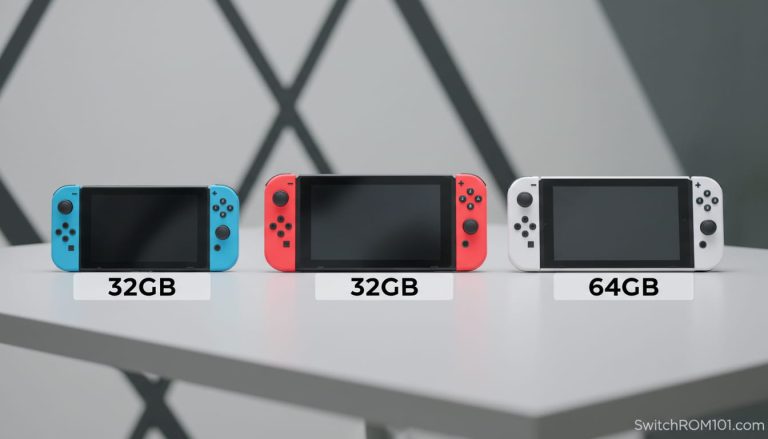
| Internal storage | 256GB (UFS) | 64GB | 32GB (V2: 32GB) | 32GB |
| Storage expansion | microSD Express only | microSD/SDXC (up to 2TB) | microSD/SDXC (up to 2TB) | microSD/SDXC (up to 2TB) |
| Battery life | 2–6.5 hours | 4.5–9 hours | V2: 4.5–9h / V1: 2.5–6.5h | 3–7 hours |
| TV/dock mode | Yes (included dock) | Yes (upgraded LAN dock) | Yes (standard dock) | NO — handheld only |
| Detachable Joy-Con | Yes (Joy-Con 2, magnetic) | Yes (standard rail) | Yes (standard rail) | NO — built-in controls |
| GameChat / C button | Yes (built-in mic) | No | No | No |
| Wi-Fi | Wi-Fi 6E | Wi-Fi 5 | Wi-Fi 5 | Wi-Fi 5 |
| USB-C ports | 2 (top + bottom) | 1 (bottom) | 1 (bottom) | 1 (bottom) |
Nintendo Switch 2 — the flagship (June 2025)
Switch 2 is the most significant hardware upgrade in Nintendo’s hybrid console line. The 7.9-inch 1080p LCD screen is substantially larger and sharper than any previous Switch model. Docked play supports 4K output via DLSS upscaling — the first time Nintendo’s hardware has matched modern TV standards. The Joy-Con 2 controllers attach magnetically instead of via sliding rails, addressing a longstanding design weakness. GameChat is built directly into the console with a hardware C button and integrated microphone.
The trade-off: battery life is the worst of all four models (2–6.5 hours), the screen is LCD rather than OLED, and at $449.99 it is the most expensive Nintendo console by a significant margin. Games have also increased in price — first-party Switch 2 titles launch at $69.99–$79.99.
Best for: Anyone buying their first Switch console, original Switch or Switch Lite owners upgrading, players who primarily game docked on a 4K TV, and anyone who wants guaranteed access to future Switch 2 exclusive titles.
Nintendo Switch OLED — the premium handheld choice
The Switch OLED launched in October 2021 as the premium version of the original Switch hardware. The 7-inch OLED screen produces genuinely superior blacks and contrast compared to any LCD — including the Switch 2’s. The upgraded dock includes a wired LAN port for more stable online play. Internal storage doubled to 64GB and speakers improved.
What the OLED is not: a performance upgrade. The Switch OLED uses identical CPU, GPU, and RAM to the original Switch. Games run at exactly the same performance on OLED as on standard Switch. You are paying for a better display, not better frame rates or resolution.
Following the August 2025 tariff-related price increase, the Switch OLED now costs approximately $400 in the US — $50 less than Switch 2. For players who predominantly game in handheld mode and value screen quality over performance, this gap is meaningful. The OLED’s 4.5–9 hour battery life is also noticeably better than Switch 2’s 2–6.5 hours.
Best for: Existing Switch OLED owners (don’t upgrade yet), players who game exclusively in handheld mode and value OLED contrast, and buyers on a tighter budget who still want a quality handheld experience.
Nintendo Switch (Standard) — the original hybrid
The original Nintendo Switch launched in March 2017. A revised V2 model released in 2019 with significantly improved battery life (4.5–9 hours vs the original’s 2.5–6.5 hours). If buying a standard Switch new, always verify it is the V2 model.
The standard Switch offers the same hybrid play (handheld and docked) as the OLED at a lower price, with the trade-offs of a smaller 6.2-inch LCD screen, less storage (32GB), and no LAN port in the dock. After the August 2025 price increase to approximately $340, the value proposition versus the OLED at $400 narrows — for most buyers, the extra $60 for the OLED screen and improved dock is worth it.
Best for: Budget-conscious buyers who want TV mode capability and cannot stretch to OLED pricing. Consider the OLED as a first choice if budget allows.
Nintendo Switch Lite — handheld-only
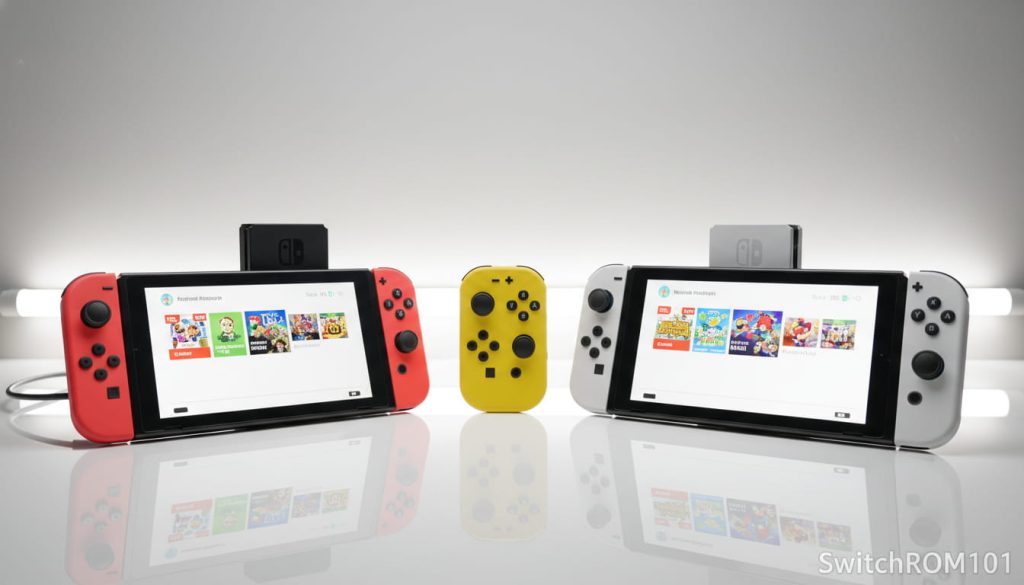
The Switch Lite is the only model that cannot connect to a TV at all — it has no dock compatibility and no video output. The controllers are built directly into the unit and cannot be detached. It is the smallest and most portable Switch at 5.5 inches and was designed specifically for handheld-only players.
Switch Lite is most appropriate for: young children (durable, compact), players who travel frequently and have no interest in TV play, and as a secondary console for households that already own a full Switch. At approximately $230 after the tariff price increase, it remains the most affordable entry into the Switch ecosystem.
Best for: Kids, secondary console for families, dedicated portable gamers with no TV play needs.
Important: Switch Lite cannot play games that require detached Joy-Con controllers (Ring Fit Adventure, Nintendo Switch Sports in some modes, Nintendo Labo). Verify game compatibility before purchasing for kids.
The 2026 pricing reality — August 2025 tariff increases
In August 2025, Nintendo raised US prices on all Switch 1 hardware citing “market conditions” related to US tariffs. The increases: Switch Lite from $200 to ~$230, standard Switch from $300 to ~$340, Switch OLED from $350 to ~$400. This narrowed the gap between original Switch models and Switch 2, changing the buying calculus significantly.
At a $50 gap between Switch OLED and Switch 2, the argument for buying Switch OLED as a budget option weakens. For most buyers spending $350+ on a Nintendo console in 2026, Switch 2 is now the stronger recommendation.
Which Switch should you buy in 2026 — quick guide
| Your situation | Recommended model | Reason |
| Buying your first Nintendo console | Switch 2 | Future-proofed, best hardware, backwards compatible with full Switch library |
| Upgrading from original 2017 Switch | Switch 2 | Large performance and display leap, all your games transfer |
| Upgrading from Switch Lite | Switch 2 | Gain TV mode, larger screen, next-gen hardware |
| Upgrading from Switch OLED (handheld gamer) | Consider waiting | OLED screen is genuinely better; Switch 2 has better specs but LCD |
| Buying for a young child | Switch Lite | Smaller, more durable, most affordable, less to break |
| Budget is under $250 | Switch Lite | Only option at this price; consider used OLED if possible |
| Primarily docked/TV gaming | Switch 2 | 4K DLSS output, best performance, 120fps support |
Frequently asked questions
Do all Switch models play the same games? Almost. Switch 2 plays both Switch 1 and Switch 2 games. Switch OLED, Switch, and Switch Lite play the same Switch 1 library with minor exceptions. Switch Lite cannot play some games that require detached Joy-Cons. Switch 2 exclusive games cannot be played on Switch 1 hardware.
Is Nintendo still making Switch 1 models? Yes. All three original models remain in production and for sale as of April 2026. Nintendo has stated no discontinuation plans.
Can I use my old Switch games on Switch 2? Yes. Physical cartridges work directly in Switch 2. Digital games transfer via your Nintendo Account. Almost all Switch 1 games are backwards compatible.
Quick answer: The Nintendo Switch offers hybrid play on TV and handheld, the Switch Lite is a budget handheld-only console, and the Switch OLED delivers the best screen and premium features.
People Also Ask
Which Nintendo Switch model is best?
The best model depends on how you play. OLED is best for handheld visuals, Lite is best for portability, and the original Switch offers balanced hybrid play.
Can Switch Lite connect to a TV?
No. The Switch Lite is handheld-only and does not support TV mode.
Is Switch OLED worth the extra cost?
Yes, if you value a larger OLED display, improved audio, and more internal storage.
Do all Switch models play the same games?
Yes. All Nintendo Switch models support the same game library.
Which Switch is best for kids?
The Switch Lite is often best for kids due to its durability, lower price, and handheld design.

(GameOverlord) has been involved in Nintendo Switch emulation
since 2019. She owns two Nintendo Switch consoles and a Steam Deck OLED,
and has hands-on tested over 40 Switch titles across Ryujinx and
Sudachi emulators. Her background is in consumer electronics and
she has followed emulation law developments in the US, UK, and EU
since the Yuzu shutdown in 2024. SwitchROM101 was built to fill the
gap left by misleading ROM sites — giving gamers accurate, legal,
and technically correct information without hosting any game files.