Switch ROM: What It Is, How It Works & the Complete Legal Guide (2026)
SwitchROM101 editorial note This site does not host, distribute, or link to Nintendo Switch game files. All content is for educational and legal research purposes only. We cover the technology, legal framework, and factual context — not acquisition.
Quick answer
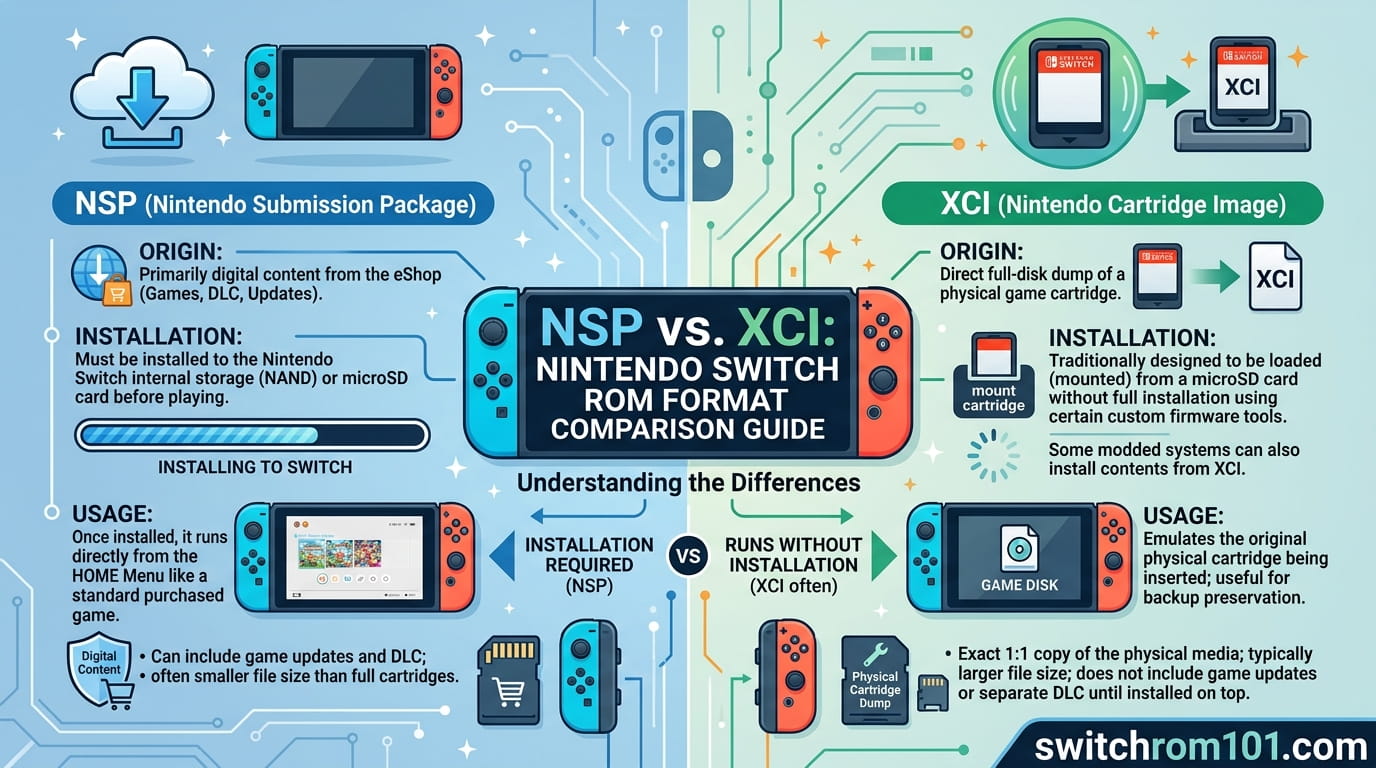
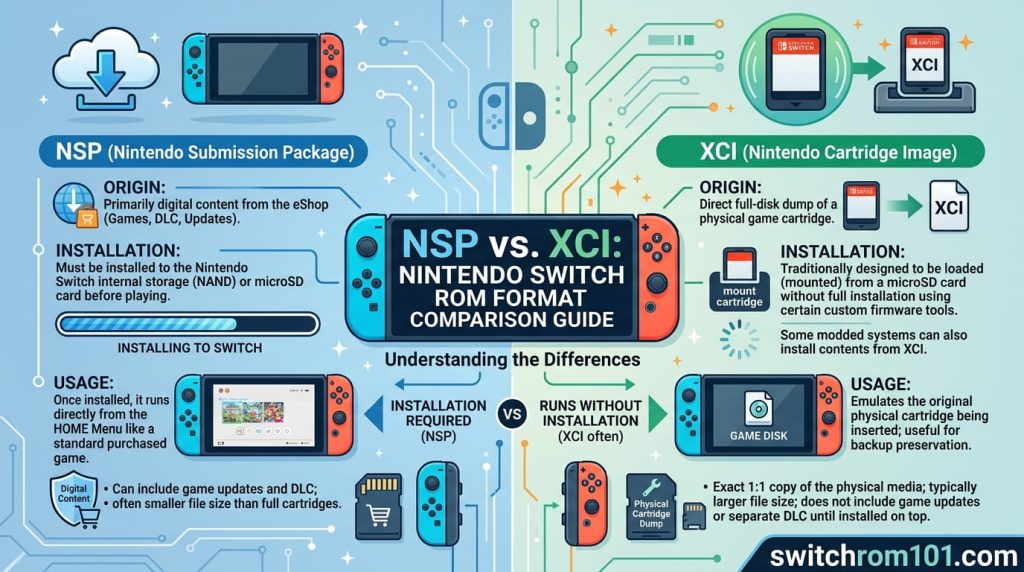
A Switch ROM is a digital file that contains the data from a Nintendo Switch game. The term “ROM” comes from Read-Only Memory — the type of chip used in older game cartridges — and has become the general term for any game data file extracted from physical or digital game media. For Nintendo Switch, ROM files come in two primary formats: NSP (Nintendo Submission Package, for digital games) and XCI (eXternal Cart Image, for cartridge dumps).
The legal status of Switch ROMs is specific and often misunderstood: the technology itself is neutral, but possession and use is only lawful when the files come from games you legally own. Downloading Switch ROM files from the internet for games you have not purchased is copyright infringement under the DMCA and equivalent laws in the UK, EU, and most other jurisdictions.
What a Switch ROM actually is — the technical explanation
The origin of the term “ROM”
ROM originally referred to Read-Only Memory — silicon chips inside game cartridges that stored game data permanently. When emulation became widespread in the 1990s, “ROM” became shorthand for any dumped copy of a game’s data, whether from a cartridge chip, optical disc, or digital download package. The term stuck even as the underlying storage technology changed completely.
For Nintendo Switch games, no part of the game data actually lives on a ROM chip — modern Switch cartridges use flash memory. But the term “Switch ROM” persists in the emulation community to mean any game data file intended for use with an emulator.
How Switch game data is structured
A Nintendo Switch game — whether purchased as a physical cartridge or downloaded digitally from the eShop — is encrypted using Nintendo’s proprietary NCA (Nintendo Content Archive) format. The game data, update data, and DLC are all packaged into NCA files, which are then wrapped into either NSP or XCI containers depending on their origin.
This encryption means that a Switch ROM file cannot simply be opened on a PC like a regular folder. It requires:
- An emulator that understands the Nintendo Switch system architecture
- Decryption keys (prod.keys) that are unique to each console — these must come from your own Switch hardware
- A system that can interpret the NCA container format
This is why Switch emulation is technically more complex than emulating older consoles — the data is encrypted and the system architecture is a custom Nvidia ARM configuration that must be recreated in software.
NSP vs XCI — the two main Switch ROM formats
| Property | NSP (Nintendo Submission Package) | XCI (eXternal Cart Image) |
| What it is | Digital game package format — mirrors how eShop games are delivered | Cartridge image format — captures the full contents of a physical game card |
| Legal origin | Digital eShop purchase tied to your Nintendo Account | Physical cartridge you own, dumped using NxDumpTool on your own console |
| Typical file size | Standard — no extra packaging overhead | Slightly larger — preserves full cartridge structure including metadata |
| Emulator handling | Load directly in Ryujinx and other emulators | Load directly; some emulators handle XCI differently than NSP |
| Updates / DLC | Managed as separate NSP files, installed to emulator | Must install game updates as NSP files separately |
| Compressed variant | NSZ (zstandard compressed — 40–80% smaller) | XCZ (same compression applied to cartridge image) |
| Best use case | Games you purchased digitally; cleaner update management | Archiving physical cartridges you legally own |
How Switch ROMs work with emulators
What an emulator actually does
A Nintendo Switch emulator is software that recreates the Nintendo Switch’s hardware environment on a different computer. The Switch runs on a custom Nvidia Tegra X1 system-on-chip with a specific ARM CPU architecture, a custom GPU, and Nintendo’s proprietary operating system (Horizon OS). None of this exists on a regular PC.
An emulator like Ryujinx translates the Switch’s ARM CPU instructions into x86 instructions that a PC processor can execute. It recreates the GPU rendering pipeline, the memory architecture, the operating system calls, and the input/output systems — all in software. This is why emulation is computationally intensive and why older CPUs struggle: the PC must do its own work plus simulate an entirely different computer simultaneously.
What the emulator needs beyond the ROM file
A ROM file alone is not enough to run a game. The emulator also needs:
- prod.keys — encryption keys unique to Nintendo Switch hardware. These must be extracted from a Nintendo Switch console you own. The keys decrypt the NCA-encrypted game data. Without them, the emulator cannot read the ROM.
- Firmware files — the Switch operating system (Horizon OS). Some games require specific firmware versions to run correctly.
- Sufficient PC hardware — at minimum a modern CPU with strong single-core performance, 8GB+ RAM, and a GPU with Vulkan API support.
The requirement for hardware-specific encryption keys is a critical legal point: it means that legally using a Switch ROM with an emulator requires owning a Nintendo Switch console (to extract the keys) and owning the game (to have a legal copy of the ROM). Both conditions must be true simultaneously.
Ryujinx — the primary maintained emulator in 2026
Ryujinx is the most widely maintained and legally uncontroversial Switch emulator available in 2026. It is open-source, developed through clean-room reverse engineering (which is legal under US copyright law), and was not subject to Nintendo’s 2024 litigation that shut down Yuzu.
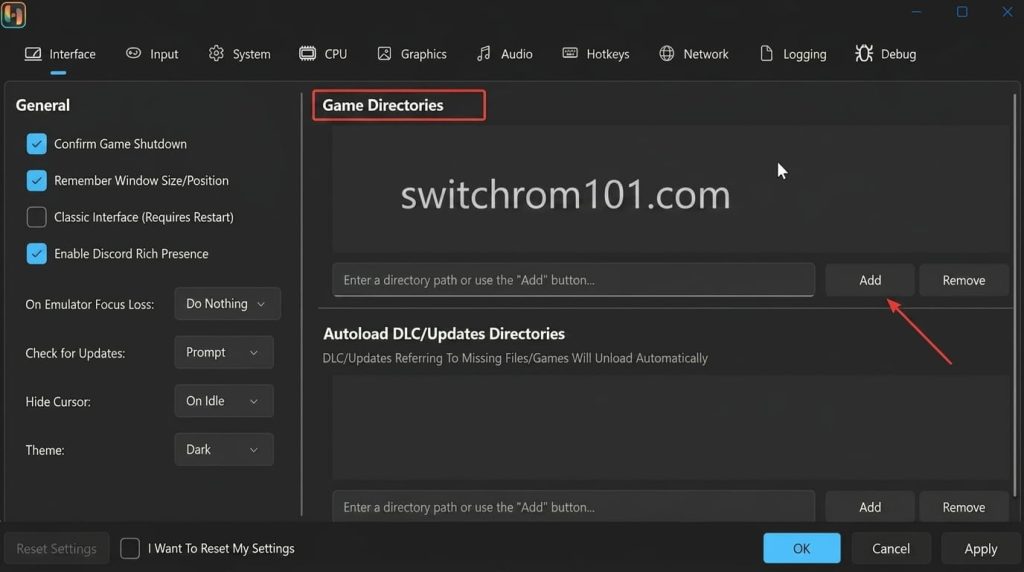
Ryujinx supports both NSP and XCI formats, handles decryption using your prod.keys, and has a compatibility database covering thousands of Switch titles. Performance varies by game — some titles run at full speed on mid-range hardware, others require high-end CPUs to achieve playable frame rates.
In March 2024, Nintendo’s $2.4M lawsuit settlement forced Yuzu’s shutdown. Any guide still recommending Yuzu as an active download is outdated. Sudachi and Citron are community-maintained forks of Yuzu’s codebase, but Ryujinx remains the primary recommendation for new users in 2026.
The complete legal guide to Switch ROMs
The foundational legal principle
The legal framework for game ROMs in most countries rests on a distinction between two separate acts: creating a copy and distributing or downloading a copy. These have different legal treatments, and conflating them is the source of most online confusion about ROM legality.
Creating a backup copy: In the United States, the 1992 Computer Software Rental Amendments Act and subsequent case law (most notably MAI Systems Corp. v. Peak Computer and Sega v. Accolade) established that owners of software have certain rights to make backup copies for personal use. However, the DMCA’s Section 1201 complicates this for modern consoles by prohibiting the circumvention of technological protection measures (TPMs) — which is exactly what extraction tools do when they bypass Switch security.
Downloading someone else’s copy: This is clearly illegal in the US, UK, EU, and most other jurisdictions. Downloading a copyrighted game you do not own is infringement regardless of whether the downloader owns a physical copy. The “I own the game so downloading a ROM is fine” argument has no legal basis in US, UK, or EU law.
What the law says in each major region
United States
The Digital Millennium Copyright Act (DMCA, 1998) is the governing law. Key provisions:
- Section 106: Copyright holders have exclusive rights to reproduce, distribute, and create derivative works from copyrighted content.
- Section 1201: Prohibits circumventing technological protection measures (the encryption on Switch cartridges and system files).
- Fair Use (Section 107): Does not generally apply to game ROM copying in court rulings. No major US court has upheld game ROM copying as fair use.
Nintendo has actively enforced these rights through legal action: the Yuzu settlement ($2.4M, 2024), multiple actions against ROM hosting sites (LoveROMs, RomUniverse), and DMCA takedowns against YouTube channels covering certain ROM-related topics.
United Kingdom
The Copyright, Designs and Patents Act 1988 (CDPA) governs copyright in the UK. The 2014 format-shifting exception that briefly permitted personal copies was struck down by the UK Supreme Court in R (British Academy of Songwriters, Composers and Authors) v Secretary of State for Business in 2015. As of 2026, there is no general personal backup exception for games in UK law.
Downloading game ROMs in the UK is infringement of the copyright holder’s reproduction right. Nintendo UK has issued takedowns and pursued legal action against UK-based ROM distribution sites.
European Union
The EU Copyright Directive (2001/29/EC) and its 2019 update (DSM Directive) govern copyright across member states. Article 4 gives copyright holders exclusive reproduction rights. Article 5 permits certain exceptions but these are narrow and do not cover personal ROM copying.
The Court of Justice of the EU (CJEU) ruled in Nintendo v. PC Box (Case C-355/12, 2014) that modchips designed to circumvent Nintendo’s protection measures were illegal under the Software Directive, even when the stated purpose was to play legitimately owned games. This ruling directly applies to the tools used to extract Switch ROMs.
What Nintendo actually enforces
Nintendo’s enforcement focuses on three categories:
- ROM distribution sites — Nintendo has successfully shut down or obtained settlements from major ROM hosting sites. RomUniverse (2021, $2.1M), RomCenter, and dozens of others have been pursued.
- Emulator developers facilitating piracy — Yuzu’s shutdown was explicitly because Nintendo demonstrated the emulator was designed to facilitate pre-release game piracy, not as a general emulation objection.
- Console bans — Nintendo’s online services detect modified firmware and ban consoles from Nintendo Network, the eShop, and Nintendo Switch Online. This is the most common enforcement action ordinary users face.
Nintendo does not systematically pursue individual private users who run ROM files of games they own on their own hardware, offline. The practical enforcement risk for private, non-distributing use is low — but the legal risk is real and varies by jurisdiction.
The one scenario that is clearly legal
Using an emulator (such as Ryujinx) to play a game file that you:
- Dumped yourself from a physical cartridge you own using NxDumpTool
- Extracted prod.keys from your own Nintendo Switch hardware
- Use only on hardware you own for personal non-commercial use
- Do not distribute or share
…represents the strongest legal case for ROM use. Even this case has legal complexity under DMCA Section 1201 (circumvention of TPMs), but it is legally distinguishable from downloading someone else’s copy of a game.
Legal caveat This article provides legal information, not legal advice. Laws vary by jurisdiction and are subject to change. If you have specific legal concerns, consult a qualified lawyer in your country.
Switch ROM formats in depth — NSZ, XCZ, and NCA
NSZ and XCZ — compressed formats
NSZ is a compressed version of NSP, and XCZ is a compressed version of XCI. Both use the zstandard compression algorithm and can reduce file sizes by 40–80% without any loss of game data. The compression is lossless — the game plays identically regardless of whether you use NSP or NSZ.
Modern versions of Ryujinx support NSZ files directly. Older builds required decompressing NSZ back to NSP before loading, but this is no longer necessary for most users on up-to-date software.
NCA files — the underlying format
NCA (Nintendo Content Archive) is the actual underlying file format that both NSP and XCI contain. NCAs hold the encrypted game content — executable code, assets, save data structure, and metadata. When an emulator loads an NSP or XCI file, it extracts and decrypts the NCA files within using your prod.keys, then executes the game code.
Users rarely interact with NCA files directly — they are internal components of the larger NSP/XCI containers. Understanding NCA exists is useful for advanced emulation troubleshooting.
Update files and DLC
Nintendo Switch games receive updates and paid DLC as separate NSP files. When using an emulator, these must be installed separately from the base game. In Ryujinx, this is done via File → Install Firmware/DLC. The base game NSP or XCI, update NSP, and DLC NSP are all distinct files that must all come from games you legally own.
Performance: what hardware you need for Switch emulation in 2026
Switch emulation performance depends primarily on CPU single-core speed, not overall CPU power. Ryujinx is largely single-threaded for game emulation, meaning a faster single core matters more than having more cores.
| Component | Minimum (720p, 30fps on most games) | Recommended (1080p–4K, 60fps) |
| CPU | Intel i5-10th gen / AMD Ryzen 5 3600 — high single-core clock | Intel i7-13700K / AMD Ryzen 7 7800X3D — top single-core performance |
| RAM | 8GB DDR4 minimum | 16GB DDR4 or DDR5 recommended |
| GPU | Any GPU with Vulkan support (GTX 1060 / RX 580) | Nvidia RTX 3060 or better for upscaling; AMD RX 6700 XT |
| Storage | SSD strongly recommended | NVMe SSD — faster shader compilation |
| OS | Windows 10/11, Linux (best performance), macOS (some limitations) | Linux with Vulkan often achieves best frame rates |
Frequently asked questions
What is a Switch ROM?
A Switch ROM is a digital file containing the data from a Nintendo Switch game. The term derives from Read-Only Memory — the storage medium of older game cartridges. For Switch, ROMs come in NSP (digital game package) and XCI (cartridge image) formats. They are used with emulators to run Switch games on PC.
Are Switch ROMs legal?
It depends on how you obtained them. Playing a ROM you dumped yourself from a physical cartridge you own, using your own console’s encryption keys, represents the strongest legal case for personal ROM use. Downloading Switch ROM files from the internet — regardless of whether you own the physical game — is copyright infringement under the DMCA (US), CDPA (UK), and EU Copyright Directive. Nintendo has successfully pursued legal action against ROM distribution sites in multiple jurisdictions.
Can I download Switch ROMs if I own the game?
This is the most common misconception. Owning the physical game does not give you the legal right to download a ROM file that someone else created and distributed. The download of a copyrighted work without authorisation is an infringement independent of whether you own a separate copy. The legal argument for personal use only applies to a copy you made yourself from media you own.
What emulator should I use for Switch ROMs in 2026?
Ryujinx is the primary recommendation in 2026. It is actively maintained, open-source, and was not involved in Nintendo’s 2024 litigation that shut down Yuzu. It supports NSP and XCI formats, runs on Windows, Linux, and macOS, and has strong compatibility across Switch titles.
What are prod.keys and where do they come from?
Prod.keys are encryption keys extracted from a Nintendo Switch console’s system firmware. They are required by emulators to decrypt and run Switch game files (NCA format). These keys must be obtained from your own Nintendo Switch hardware — either by dumping them using homebrew tools on a compatible console, or from a console you own. Downloading prod.keys from the internet is not legal because they contain proprietary Nintendo firmware data.
What is the difference between NSP and XCI?
NSP represents a digital game package — the same format Nintendo uses for eShop downloads. XCI represents a cartridge image — a dump of the full physical game card. Both contain the same game data but packaged differently. For emulators, NSP is slightly easier to manage for updates and DLC. XCI is the natural output format when dumping physical cartridges you own.
What happened to Yuzu?
Yuzu, developed by Tropic Haze LLC, was shut down in March 2024 following a $2.4 million lawsuit settlement with Nintendo. Nintendo demonstrated that Yuzu was used to play pre-release copies of The Legend of Zelda: Tears of the Kingdom. Community forks including Sudachi and Citron continue development, but Yuzu itself is no longer maintained.
Can I play Switch ROMs on Steam Deck?
Yes. The Steam Deck runs Linux and can run Ryujinx via EmuDeck, which automates emulator installation and configuration. Performance varies by game — most first-party Nintendo titles run well at 720p/60fps with correct Vulkan settings. See our Steam Deck emulation guide for hardware-specific configuration details.
What is Nintendo’s enforcement history with ROMs?
Nintendo is the most aggressive major video game publisher in pursuing ROM-related enforcement. Major actions include: LoveROMs/LoveRetro ($12M settlement, 2018), RomUniverse ($2.1M, 2021), Yuzu ($2.4M, 2024). Nintendo also filed suit against the US government over tariffs in 2026. Their enforcement focuses on distribution infrastructure, not individual private users — but legal exposure exists regardless of enforcement priority.
Does Nintendo ban consoles for using ROMs?
Yes, Nintendo can detect modified firmware and unusual game-license activity when a console connects to Nintendo’s servers. Consoles detected with custom firmware or running game files with suspicious license data are permanently banned from Nintendo Network, Nintendo eShop, and Nintendo Switch Online. Bans are applied to the console hardware, not just the Nintendo Account — a banned console cannot be unbanned.
What is a Switch ROM site and are they safe?
Switch ROM sites are websites that distribute Nintendo Switch game files (NSP, XCI) without Nintendo’s authorisation. They are illegal — distributing copyrighted game files without a license is infringement. Beyond legal risk, these sites frequently contain malware, fake files, phishing traps, and cryptocurrency scams. Our safety guide covers the specific threats in detail.
Related guides on SwitchROM101
This cornerstone article connects to our full library of in-depth guides:
Can you go to jail for downloading Switch ROMs? — legal risk explained
Is Switch emulation legal in the US, UK & EU? — Full DMCA and copyright law breakdown
XCI vs NSP formats explained — technical comparison for emulation users
Best Nintendo Switch emulators in 2026 — Ryujinx vs Sudachi vs Citron compared
Are Switch ROM websites safe? — Malware, scams, and phishing risks explained
Switch ROM legal risks — what Nintendo actually enforces and what the law says
How Switch emulation works on Steam Deck — full setup and performance guide
Best CPU for Switch emulation in 2026 — hardware recommendations
What are prod.keys? — technical explanation and legal context
SwitchROM101 is an independent educational resource. We do not host, distribute, or provide links to Nintendo Switch game files (ROMs) in any format. We do not provide instructions for obtaining game files from any external source. All technical and legal information is provided for educational purposes. Nintendo, Nintendo Switch, and related marks are trademarks of Nintendo Co., Ltd. — SwitchROM101 is not affiliated with or endorsed by Nintendo.

(GameOverlord) has been involved in Nintendo Switch emulation
since 2019. She owns two Nintendo Switch consoles and a Steam Deck OLED,
and has hands-on tested over 40 Switch titles across Ryujinx and
Sudachi emulators. Her background is in consumer electronics and
she has followed emulation law developments in the US, UK, and EU
since the Yuzu shutdown in 2024. SwitchROM101 was built to fill the
gap left by misleading ROM sites — giving gamers accurate, legal,
and technically correct information without hosting any game files.